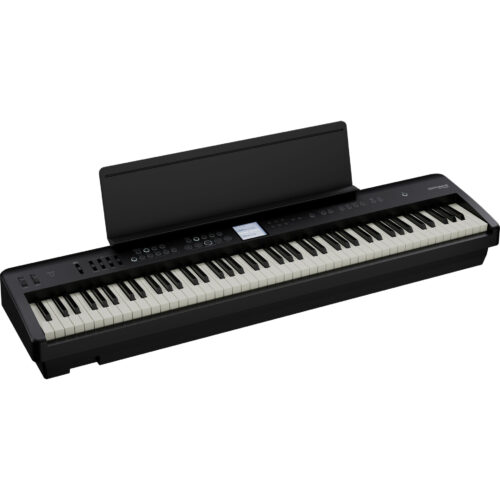

What Is A Graded Hammer Action?
If you are shopping for a digital piano, you will see a lot of terms that sound similar: weighted keys, hammer action, graded hammer action, and sometimes graded hammer standard or scaled hammer action. They are not marketing fluff. They describe how the keys feel under your fingers, and that feel directly affects technique, control, and how enjoyable the instrument is to play.
A Graded hammer action is a key action designed to mimic the feel of an acoustic piano by making the keys heavier in the bass and lighter in the treble, just like an acoustic piano where larger hammers are used for lower notes and smaller hammers for higher notes.
This article breaks down what a graded hammer action really means, why it matters, and what to look for when you compare digital pianos.
What do different companies call their actions?
Yamaha – Graded Hammer Action
Roland – Progressive Hammer Action
Casio – Hybrid Hammer Action
Quick Definition
Graded hammer action: A weighted key mechanism where the lower keys require more force to press than the higher keys, imitating the natural “heavy-to-light” feel of an acoustic piano across the keyboard.
Why acoustic pianos feel heavier in the bass
Acoustic pianos are not uniform machines. Lower notes use longer, heavier strings and larger hammers. That physical difference creates natural resistance in the bass and a lighter feel in the treble.
Digital pianos do not have strings to strike, but better digital actions recreate the resistance pattern using internal weights and a hammer-style mechanism. That is what “graded” is trying to copy. The physics of an acoustic piano, not just the shape of the keys.
Graded hammer action vs weighted keys vs hammer action
These terms get thrown around like they mean the same thing. They do not.
Weighted keys
- A broad label that only means the keys have some resistance.
- It does not guarantee grading, realism, or a true piano-style mechanism.
- “Weighted” can range from decent to disappointing depending on the model.
Hammer action
- Usually means the resistance comes from a hammer-style mechanism (or a simulation of one).
- More piano-like than springy synth actions.
- May or may not be graded.
Graded hammer action
- Hammer action plus a resistance curve across the keyboard.
- Bass keys feel heavier. Treble keys feel lighter.
- Typically the baseline for players who want acoustic-like feel and skill transfer.
Comparison: Key-action types buyers confuse
Semi-weighted
- Feel: Light resistance, fast return
- Best for: Synth, organ, portability
- Drawback: Does not build acoustic piano technique well
Weighted keys (generic)
- Feel: Some resistance, varies widely
- Best for: General playing
- Drawback: Term is vague. Can be misleading
Hammer action
- Feel: More piano-like resistance
- Best for: Serious practice
- Drawback: May not be graded. Feel varies a lot
Graded hammer action
- Feel: Heavier bass, lighter treble
- Best for: Technique, expression, acoustic transfer
- Drawback: Still differs by brand and model. Must be tested
Why a graded hammer action matters
If you are learning piano, the action is not a small detail. It is the interface between you and the instrument. The wrong action can teach sloppy habits because it makes everything feel easier than an acoustic piano.
A Graded hammer action supports:
- Stronger technique
Builds real control and finger strength instead of “typing” on light keys. - Better dynamics
Makes soft-to-loud playing more predictable and controllable. - Realistic transfer to acoustic pianos
Reduces the shock when you play acoustic pianos at lessons, church, school, or performances. - More expressive playing
Helps with classical, jazz, worship, songwriting, and any style where touch matters.
VIDEO: A Graded Hammer Action Pt 2
Transcript summary:
This video demonstrates the difference you should feel between the bass and treble ends of the keyboard. It highlights what digital pianos are trying to mimic in an acoustic piano.
Idea: Make a video showing what to test/how to test the actions 5min basically following the below tests
How to test a graded hammer action in a showroom fast
You can tell a lot in five minutes if you test the right things.
1) The scale test (graded feel check)
- Play a slow scale from the lowest notes to the highest notes.
- You should feel a gradual reduction in resistance moving to the right.
2) The soft-playing test
- Play very softly in the middle register.
- Good actions stay consistent and controllable at low volume.
3) The dynamic range test
- Play the same chord quietly, then loudly.
- Good actions let you control volume with your hands, not just the volume knob.
4) The repeated-note test
- Repeat a single note quickly.
- Better actions and sensors retrigger cleanly and predictably.
5) The back-of-key test
- Play farther back on the keys (closer to the fallboard).
- Some actions feel fine near the edge of the key but become harder to control farther back.
Features that change the feel (even when both say “graded”)
Two pianos can both claim to have a graded hammer action and still feel very different. Here is why.
Escapement simulation
- Some digital actions simulate the subtle “release” sensation found in grand piano actions.
- Not everyone cares, but advanced players often notice it.
Sensor design (including triple-sensor actions)
- More advanced sensing can improve repetition and consistency.
- It can matter if you play fast passages or repeat notes often.
Pivot length and key geometry
- Longer pivot length often feels more controllable.
- Especially noticeable when playing farther back on the keys.
Key stability and construction
- How solid the keys feel and how consistent the resistance is matters as much as the label.
- This is why side-by-side testing is so important.
What a graded hammer action does not guarantee
Be honest about what you are buying.
- It does not guarantee concert grand realism.
Digital actions vary and none perfectly replicate a high-end acoustic action. - It does not guarantee “best for everyone.”
Some players prefer lighter actions for synth or organ styles. - It does not guarantee quality.
The phrase can appear on entry models and premium models. Testing still matters.
Middle Tennessee’s Digital Piano Headquarters
Shopping from specs is a trap because “graded hammer action” can feel different from one brand to another. The fastest way to choose the right action is to play multiple digital pianos side by side.
That is why our showroom is positioned as Middle Tennessee’s Digital Piano Headquarters. We keep a large variety of digital pianos available to try so you can compare key actions, speaker systems, cabinet styles, and overall feel in one visit.
When you can move from one model to another immediately, the differences become obvious fast. People who thought “all weighted keys are the same” change their mind in minutes.
Come feel it in person
If having a graded hammer action is on your must-have list, do not buy from a spec sheet. Come play it.
Visit our showroom and compare digital pianos side by side. Our experienced team will guide you through the differences, help you narrow down the right action for your playing style, and make sure you leave with something that fits your hands, your space, and your goals. You will learn more in one visit than from hours of online research.
FAQ
Is a graded hammer action the same as fully weighted keys?
Not exactly. “Fully weighted” usually means resistance across the keyboard. “Graded” means the resistance changes across the keyboard, heavier in the bass and lighter in the treble. Many graded actions are also fully weighted, but the terms are not identical.
Do beginners need a graded hammer action?
If your goal is technique that transfers to acoustic pianos, graded hammer action is one of the smartest features to prioritize early.
How do I know if the grading is good?
Play a slow scale from the lowest notes to the highest notes. The change should feel gradual and natural, not sudden.
Does a graded hammer action make playing harder?
It can feel heavier at first, especially in the bass. That resistance helps build control and better dynamics over time.